
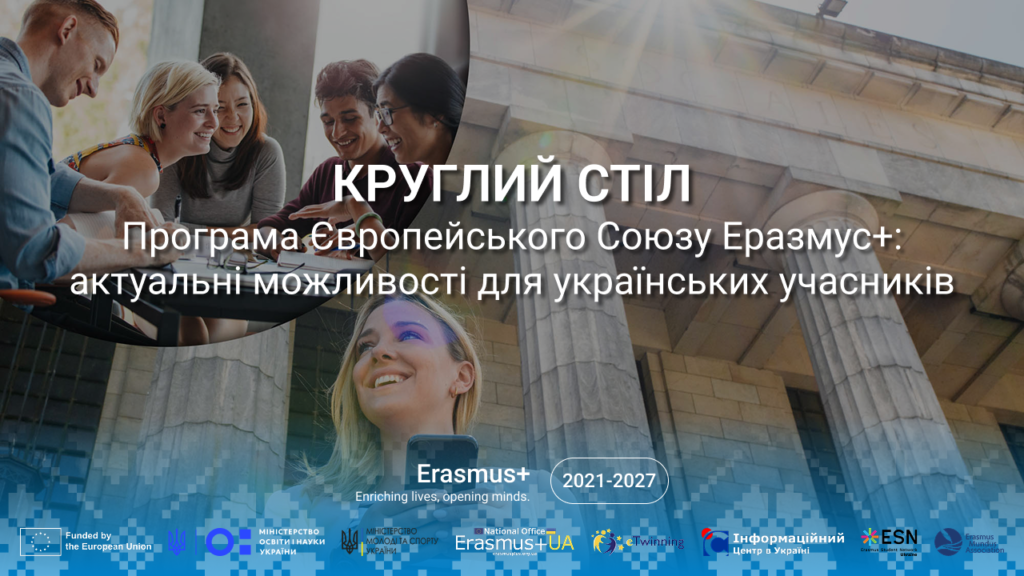
ROUND TABLE Opportunities within EUs Erasmus+ Programme for Ukraine (priorities, preparation to new status, specifics etc.) (10.12.2025, online)
On 10 December 2025, within the Erasmus+ Programme Information Days, the ROUND TABLE “Opportunities within EUs Erasmus+ Programme for Ukraine (priorities, preparation to new status, specifics etc.)” was organised. The event was organized with the support of the European Education and Culture Executive Agency (EACEA), the Delegation of the European Union to Ukraine and the Ministry of Education and Science of Ukraine.
More than 80 participants (offline) and 250 (online) joined the event.
AGENDA – available via the link
Welcoming remarks were delivered by Mykola TROFYMENKO, Deputy Minister of Education and Science of Ukraine; Kateryna DUKHNYCH, Education Sector Manager at the EU Delegation to Ukraine; Svitlana SHYTIKOVA, Coordinator of the National Erasmus+ Office in Ukraine; and Oleksandr TARASENKO, Director of the Department of Education, Science and Sports of the Ministry of Internal Affairs of Ukraine. In their speeches, the speakers emphasised the strategic role of the EU Erasmus+ Programme in supporting education reforms, fostering international cooperation, and strengthening the institutional capacity of Ukrainian education institutions in the context of European integration and martial law.
The first thematic presentation focused on national priorities in the field of education for participation in the EU Erasmus+ Programme calls in 2026. Mykola TROFYMENKO outlined key directions of state education policy to be taken into account when preparing project proposals, highlighted the importance of aligning projects with national development strategies and ongoing reforms, and answered participants’ questions during the Q&A session.
In the presentation “Ukraine’s Path towards Associated Participation in the European Union Erasmus+ Programme: Key Steps”, Oleksandra HUSAK, Director General of the Directorate for European and Euro-Atlantic Integration of the Ministry of Education and Science of Ukraine, presented the main stages and institutional processes related to Ukraine’s preparation for associated participation in the Programme, outlined achievements and further tasks, and provided clarifications during the Q&A session.
Issues related to the implementation of international technical assistance projects where the Ministry of Education and Science of Ukraine acts as a beneficiary were addressed by Tetiana MOVCHAN, Head of the Expert Group on Euro-Atlantic Integration and Cooperation with Development Partners. Her presentation focused on practical aspects of managing such projects, coordination with donors, and ensuring the sustainability of results, followed by a Q&A session.
A separate block was devoted to the specifics of participation of certain categories of students and staff of higher education institutions in activities of EU Erasmus+ Programme projects. Olha KOTOVA, Head of the Academic Mobility and Cooperation with Foreign Students Unit of the Directorate for International Cooperation, explained regulatory and organisational aspects of participation, including issues of accessibility, mobility, and participant support, and answered participants’ questions.
Within the round table, a number of thematic presentations were also delivered. Hanna TERESHCHENKO, Deputy Director of the State Scientific Institution “Institute of Educational Analytics”, presented the Eurydice education information system, focusing on the publication and updating of data on Ukraine’s education system and their importance for international cooperation.
Vasyl FEDIUK, Member of the National Qualifications Agency, highlighted the role and areas of activity of the national centres EQF, Europass, Euroguidance, and Eurodesk, emphasising their significance for the development of qualifications, mobility, and career guidance in the European context.
The results of Ukraine’s participation in the Horizon Europe Programme were presented by Olha POLOTSKA, Executive Director of the National Research Foundation of Ukraine, and Ihor TARANOV, Head of the “Horizon Europe Office in Ukraine”. The speakers outlined the current state of participation, prospects, key challenges, and possible ways to overcome them, followed by a Q&A session.
After the lunch break, participants’ attention was focused on the specific features of the EU Erasmus+ Programme calls for 2026 for Ukrainian higher education institutions and research organisations. Svitlana SHYTIKOVA, Coordinator of the National Erasmus+ Office in Ukraine, provided a detailed overview of current opportunities, participation requirements, and key aspects of preparing project proposals.
In her subsequent presentations, Svitlana SHYTIKOVA also addressed institutional aspects of Ukraine’s preparation for associated membership in the EU Erasmus+ Programme, in particular compliance with the provisions of the Erasmus Charter for Higher Education (ECHE) and the Erasmus Student Charter, as well as the topic of inclusiveness of education institutions and preparation of students and staff of higher education institutions for participation in international academic mobility.
The final thematic presentation was delivered by Olha BABCHUK, Communication Manager of DOCU/CLUB, and focused on Docudays UA and DOCU/CLUB initiatives for Ukrainian universities as tools for international diplomacy, teaching, and learning.
The event concluded with a general discussion, summarising of key outcomes, and informal networking, which facilitated the exchange of views, establishment of professional contacts, and deeper understanding of current opportunities offered by the EU Erasmus+ Programme for Ukrainian participants.